


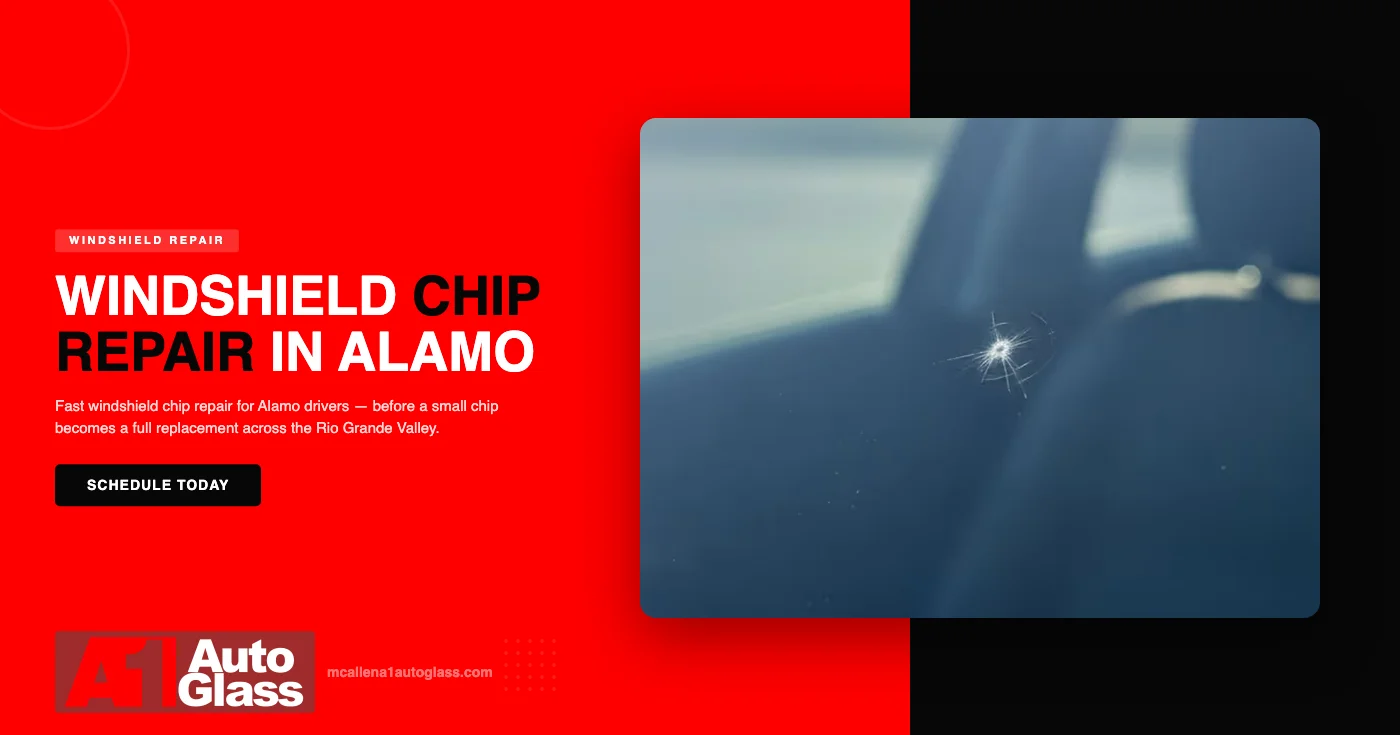
You're driving down Business 83 in Alamo, TX. Something small pings off your windshield — a piece of gravel from the pickup ahead, maybe a chunk of shell from the farm road you turned off. A tiny star chip appears in the glass. The first question every driver asks: how long can I keep driving with this before it turns into a real problem?
The honest answer from our team at A1 Auto Glass: not as long as you think. In the Rio Grande Valley climate, a fresh chip stays repairable for days — sometimes a couple of weeks — but the countdown starts the moment the impact happens. Below, we break down what causes chips on Alamo roads, how to tell whether yours is still repairable, why South Texas heat runs a hidden clock on the damage, and what a fast, professional windshield chip repair in Alamo, TX actually looks like.
What Causes Windshield Chips on Alamo, TX Roads?
Alamo drivers hit a specific mix of road conditions that make windshield chips more common here than in a lot of Texas cities. Business 83 and Expressway 83 carry heavy freight — produce trucks running from Valley packing houses to the border, agricultural equipment moving between fields, and construction traffic serving the growing McAllen and Pharr corridors. Trucks kick up gravel, tire rubber, and small road debris at highway speeds, and much of it ends up striking windshields on vehicles following behind.
Outside the highway, Alamo's farm-to-market roads and residential streets add their own hazards. Caliche shoulders shed loose stones that get flung by passing tires, and recent road work along FM-495 means temporary gravel patches and construction debris drivers can't always see. Even parking-lot bumps and pebbles falling from a truck bed can leave a fresh star on the glass overnight.
The Difference Between a Chip and a Crack — and Why It Matters
Chip and crack are often used interchangeably by drivers, but for auto glass repair they mean two very different things — and the difference determines whether you need a 30-minute fix or a full windshield replacement.
A chip is a small impact point where a piece of gravel or debris struck the outer laminate. Chips take common shapes: bullseye (a round mark like a target), star break (a small point with short lines radiating out), combination break (bullseye plus star), and pit or nick (a shallow surface chip with no radiating fractures). Most are the size of a dime or smaller when they first appear.
A crack is a line fracture that has traveled across the glass. Cracks can start at an existing chip and spread outward, or start at the edge of the windshield and travel inward. Once a crack passes about three inches, most repair systems can't restore the structural integrity — replacement becomes the only path.
The auto glass industry standard, referenced in AAA's guidance on windshield repair versus replacement, is that chips smaller than a quarter and cracks shorter than three inches are strong candidates for resin-injection repair. Miss that window and the same damage that could have been a small repair bill becomes a full replacement — three to four hours, a larger bill, and on most 2018-and-newer vehicles it also triggers an ADAS recalibration because the forward-facing camera mounts to the windshield.
How South Texas Heat Accelerates Windshield Chip Damage
The Rio Grande Valley climate is the hidden reason chips spread faster in Alamo than in cooler regions. It's a daily cycle that pulls on every existing chip and grows the fracture a little further each time the temperature swings.
Glass expands when hot and contracts when cool. A chip already fractures the outer layer of the laminate, and every heat cycle acts on the edges of that fracture as stress concentration points. Under a summer sun in Alamo, a parked vehicle's dashboard can reach 180°F while the windshield glass climbs past 140°F. Crank the AC to full and shoot 65°F air across the interior surface — the temperature differential creates thermal shock, and any existing chip is exactly where that shock concentrates. Chips that were stable at sunrise regularly run into full cracks by the time a driver reaches the H-E-B on Frontage Rd.
Three more Valley conditions accelerate the spread:
- Humidity and moisture intrusion. RGV humidity runs 60 to 85% year-round. Water vapor works into the microscopic gap of a chip, and every temperature swing pulls the fracture open a little further.
- Road vibration. Rough patches on FM-495, gravel shoulders, and expansion joints on the highways all vibrate the surrounding glass. Over time, that fatigue extends the fracture.
- Cabin pressure changes. Closing a door briefly pressurizes the cabin and pushes outward on the windshield — enough to run a chip further, especially after a hot afternoon when the glass is already stressed.
Why Waiting Too Long Is Costly for Alamo, TX Drivers
Deciding to "keep an eye on it" is the most common mistake we see from Alamo drivers who come in later for full replacement. The cost delta between an early chip repair and a delayed replacement is the biggest reason to schedule immediately.
A typical windshield chip repair runs $75 to $125 out-of-pocket — or often $0 with comprehensive insurance, because most carriers waive the deductible for chip repair. A full windshield replacement runs several hundred dollars for a basic vehicle and can climb past $1,000 once you factor in ADAS recalibration on a 2018-or-newer camera-equipped vehicle. On some luxury and EV models the replacement plus recalibration bill reaches $1,500 to $2,500.
The time cost is also different. A chip repair takes 30 to 45 minutes and can be done from our shop or via mobile service. A full replacement is two to four hours, plus 24 hours of light restrictions during the initial adhesive cure. There's a structural argument too: a repaired windshield keeps its factory seal — the original bond engineered by the manufacturer for airbag deployment and roof-crush resistance. According to IIHS research on vehicle structure, the windshield contributes to the cabin's roof-crush strength and supports the passenger airbag on frontal impact — and every chip repair we complete preserves that engineering.
What to Expect During a Professional Windshield Chip Repair
A windshield chip repair in Alamo, TX at A1 Auto Glass takes 30 to 45 minutes from arrival to drive-away. Here's what happens during the appointment.
- Inspection. Our technician examines the chip from both sides of the glass, measures the damage, and confirms it falls inside repair guidelines: smaller than a quarter, not in the driver's primary line of sight, and hasn't penetrated the inner laminate layer. If it's outside those limits, we walk you through replacement before doing anything else.
- Cleaning the fracture. A precision tool draws dust, moisture, and micro-debris out of the fracture. A contaminated chip doesn't bond cleanly to repair resin — the result is a visible blemish instead of a clean fix.
- Resin injection. Optical-grade polymer resin is injected into the fracture under controlled pressure and vacuum. The vacuum pulls air out; the pressure pushes resin in and fills the fracture completely.
- UV cure. An ultraviolet lamp hardens the resin in three to five minutes, chemically bonding it to the glass and restoring structural integrity at the impact site.
- Polishing and inspection. Excess resin is scraped flat and the surface is polished. Most repairs leave only a faint mark visible from a foot or two away.
If you can't make it to our shop, our mobile auto glass service handles chip repair in Alamo driveways, workplaces, and fleet yards. Most mobile chip repairs finish in under an hour at your location — no travel fee anywhere in the Rio Grande Valley.
Once the resin has cured, the windshield is ready to drive normally. There's no waiting period, no restrictions on car washes, and no ADAS recalibration required — because we haven't removed the glass and the forward camera stays aimed exactly where the automaker set it.
Does Texas Insurance Cover Windshield Repair in Alamo?
Most Texas comprehensive auto policies cover windshield chip repair — and many waive the deductible entirely for repair, because carriers know a $75 to $125 repair is dramatically cheaper than the $500-to-$2,500 replacement that follows if the chip is ignored. It's one of the few situations in auto insurance where the incentives line up cleanly for the driver.
- Confirm coverage. Look for "comprehensive" or "other than collision" on your policy declaration page — that's the coverage that pays for glass damage. Liability-only policies do not cover it.
- Ask about the glass deductible. Individual carriers routinely offer full glass coverage, glass endorsements, or waived deductibles for repair-only claims. A quick call to your agent confirms it — many Alamo drivers are surprised to learn chip repair is free to them.
- Bring your policy info. We handle direct billing to most major carriers — Progressive, State Farm, USAA, Allstate, Geico, Farmers, and others. We pull the claim number from your card and submit the invoice.
- Repair claims typically don't affect premiums. Because chip repair prevents a larger loss, most carriers treat it separately from at-fault claims. Confirm with your agent, but as a rule, filing a chip repair claim is one of the few "free" repairs available to comprehensively-insured Texas drivers.
Schedule Your Repair: Serving Alamo and the Rio Grande Valley
If you've got a chip on your windshield right now, the smart move is to book the repair this week — before the next hot afternoon runs the fracture into a full crack. A1 Auto Glass serves Alamo and the surrounding Rio Grande Valley with expert windshield chip repair, mobile service, direct insurance billing, and free inspections before any work begins.
We're based in McAllen at our full-service shop, and our mobile trucks reach Alamo, Donna, San Juan, Pharr, Weslaco, and every RGV community. Same-day and next-day appointments are usually available, and bilingual service in English and Spanish is standard on every call.
Frequently Asked Questions About Windshield Chip Repair in Alamo, TX
How long can I drive with a chip before it needs repair?
There's no fixed timeline, but in Alamo's climate most chips begin to spread within one to two weeks of the impact — and we've seen chips run into full cracks the same afternoon they happened when the vehicle sat in direct sun. Book windshield chip repair in Alamo, TX as soon as you notice the damage. The longer you wait, the more likely you'll need a full replacement instead.
How much does a windshield chip repair cost in Alamo?
Out-of-pocket, most chip repairs run $75 to $125 depending on the size and complexity of the damage. With comprehensive auto insurance in Texas, most carriers waive the deductible for chip repair, meaning the repair is often free to the driver. We provide a written estimate before starting work.
Will a chip repair be invisible after the fix?
Most repairs leave a small faint mark visible up close. The goal of chip repair is structural restoration and stopping the spread — not full cosmetic invisibility. Drivers who want a completely clear windshield typically choose replacement instead.
Do you offer mobile windshield chip repair in Alamo?
Yes. Our mobile auto glass trucks reach Alamo every week from our McAllen base. Driveways, workplace parking lots, and fleet yards all work as long as there's a level surface. Most mobile chip repairs finish in under an hour — no travel fee anywhere in the Rio Grande Valley.
Does chip repair require ADAS recalibration afterward?
No. Recalibration is required after full replacement because removing and reinstalling the glass shifts the camera aim. Chip repair leaves the glass in place — no recalibration needed, and lane-keeping, adaptive cruise, and forward-collision systems keep working as before.
Ready to schedule? Contact A1 Auto Glass for windshield chip repair in Alamo, TX — expert resin injection, insurance billing handled on our end, and a fast return to driving with a windshield that's ready for another Valley summer.