

You leave the H-E-B parking lot on a 102-degree afternoon in Edinburg, hit the AC, and that quarter-sized chip in your windshield — from last week's gravel hit on the 281 — grows a six-inch tail. That's South Texas physics. A chip that would sit harmlessly in a milder climate behaves very differently when the glass is touching 150°F and the cabin gets shocked with cold air. Here's the difference between a chip and a crack, when each is repairable, when replacement becomes necessary, and what Edinburg drivers should expect.
How South Texas Summer Heat Spreads Windshield Damage
The Rio Grande Valley delivers some of the most aggressive thermal conditions in the country for auto glass. Surface temperatures on a windshield parked in direct sun in Edinburg during July can climb past 150°F, even when the air is 98°F. The outside glass is hot, the cabin is much cooler the moment you crank the AC, and the temperature differential puts the laminated pane under bending stress it was never asked to absorb.
That stress finds the weakest point — whatever existing damage you already have. A pin-sized chip from gravel on Closner Boulevard can sit dormant for weeks in cooler weather. The first 100-degree afternoon, the same chip can run two, four, or eight inches in a single thermal cycle. The call comes in not when the chip happened, but when the heat finally pushed it.
The pattern isn't only summer-to-summer. It's day-to-day. Glass that was fine in the morning can crack from a cold car wash rinse, from cold AC blown onto the inside of the windshield, or from a slammed door that flexes the body. In Edinburg's June through September stretch, the margin for a "we'll get to it later" chip disappears.
Windshield Chip vs. Crack: What's the Real Difference?
The terminology matters because each kind of damage behaves differently and triggers different repair decisions.
A chip is a point of impact — a small piece of the outer glass layer is missing or fractured, but the laminated pane is still intact. Auto glass technicians categorize chips by shape: a bullseye is a clean circular impact with a dark center, a star break radiates short legs from a central point, a combination mixes both patterns, and a pit is a small surface pock with no legs. Most chips are smaller than a quarter at the time they happen.
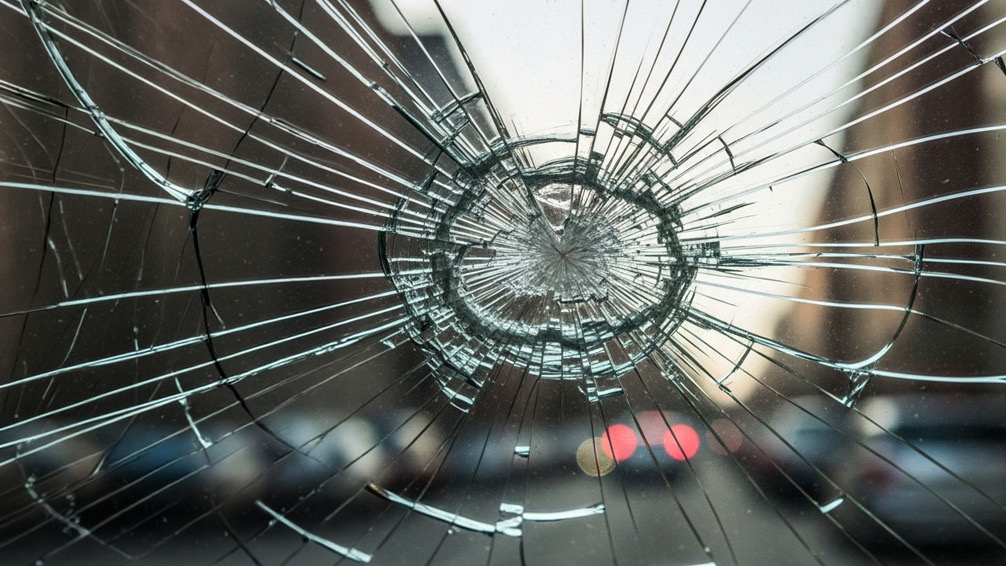
A crack is a continuous line across the glass. Cracks can start as the natural progression of a chip — those star-break legs extending — or as a stand-alone fracture from thermal stress, structural flex, or a heavier impact. They're judged by length, location, and whether they've reached the outer edge.
The distinction matters because chips are usually repairable and cracks usually are too — but only up to a clear threshold. Past that threshold, no resin injection will restore the structural condition the glass needs. In South Texas, that threshold gets crossed faster than anywhere else in the country.
Repair Window: When a Chip Can Still Be Saved
The AGSC repair standard — the one we follow on every Edinburg job — gives a clear repair window. A windshield chip can almost always be repaired if it meets these four conditions:
- Smaller than a U.S. quarter (about 1 inch across). Bigger than a quarter and the structural bond from resin injection no longer reliably holds.
- Outside the driver's primary vision area. The strip directly in the driver's forward line of sight is held to a stricter standard — any visible repair scar in that area is a problem.
- At least two inches from the outer edge of the pane. Edge damage is structural damage. Once the chip is at the frame, the glass has already lost some of its bond to the urethane.
- Clean and uncontaminated. Dirt, water, wax, or car wash chemicals that get into the chip before repair break the resin bond. The faster a chip is sealed, the better the cosmetic and structural result.
Cracks have a similar repair window. A single, clean crack shorter than about three inches, sitting outside the driver's vision area and not touching the edge, can usually be repaired with the same resin process. Our rock chip repair service handles bullseyes, stars, and short cracks alike — typically 20 to 30 minutes per impact, with the vehicle road-ready the moment we're done. For more on repair-only situations, our windshield repair page walks through the full process.
Replace Threshold: When Damage Crosses the Line
Replacement becomes the right call once the damage crosses any of the following thresholds:
- A crack longer than six inches. AAA's published guidance treats six inches as the practical upper bound for a reliable repair — see AAA's windshield repair and replacement guidance.
- Damage in the driver's primary vision area. Even if a repair would technically hold, a residual scar in the sight line is a visibility risk.
- Damage at or near the outer edge. Once a crack reaches the frame, the windshield has lost some of its structural bond. No resin can restore the load path needed to support the roof in a rollover.
- Multiple impacts clustered together. Three or more chips within a small area weaken the surrounding glass past what spot repair can hold.
- Damage through both glass layers. A windshield is two layers of glass laminated around a vinyl interlayer. Damage that has compromised both layers is past repair.
- Contamination or weathering. A chip open to the elements for weeks usually won't bond cleanly with resin.
Modern windshields handle responsibilities the original pane didn't — roof crush resistance in a rollover, airbag deployment geometry in a frontal collision, and the mount for the forward-facing ADAS camera. Our windshield replacement service uses OEM-equivalent glass, manufacturer-spec urethane with cure times calibrated for South Texas heat, and ADAS recalibration where the vehicle requires it.
Why Edinburg, TX Drivers Should Act Within Days, Not Weeks
The single most expensive mistake we see in Edinburg is the "I'll get to it next paycheck" decision on a fresh chip in June, July, or August. A chip caught the first week is typically a $75-to-$150 repair (often zero out of pocket — see insurance below). The same chip after a month of Valley heat has spread into a six-inch crack and become a $300-to-$700 replacement, plus ADAS recalibration on a newer vehicle.
- Sustained extreme heat. The Valley runs 95°F-plus from late May through September — a four-month window where every parked car sits under glass-stressing surface temperatures.
- Heavy highway gravel exposure. The 281, the I-2 / US 83 corridor, the FM roads serving the colonias, and the agricultural traffic out toward the citrus operations all kick up loose gravel.
- Hidden moisture in fresh damage. Edinburg's overnight humidity sits at 70-to-90% much of the summer. That moisture wicks into open chips, blocks resin from bonding, and turns a repair-eligible chip into a replace-only problem.
- Driver visibility risk. A crack in the wiper sweep area refracts low-angle sun on the morning and evening drives.
The practical rule we give every customer: if you can see the chip from outside the vehicle, schedule the repair within seven days.
How A1 Auto Glass Evaluates Damage for Edinburg Customers
When an Edinburg customer brings a damaged windshield to us — or has us come to them through mobile service — the inspection follows the same five steps every time.
- Measure and map. We measure each chip and crack with a caliper, photograph the damage with a contrast card, and mark the location relative to the driver's vision area and the edge.
- Check for moisture and contamination. We test whether the impact site is dry and uncontaminated. Where possible we'll dry the chip with controlled heat before repair.
- Identify the ADAS profile. We look behind the rearview mirror for the forward-facing camera and pull the vehicle's ADAS profile — that tells us whether replacement will trigger required recalibration.
- Make the repair-vs-replace call against the standard. We apply the AGSC thresholds — size, location, edge proximity, contamination — and recommend the option that meets the structural standard at the lowest cost to you.
- Show you the math. We walk through cost, insurance treatment, cure time, and warranty before any work begins.
Every job leaves with a written warranty, before-and-after photos, and (when applicable) an ADAS recalibration report for your insurance carrier or fleet maintenance file.
Cost and Insurance Considerations for Edinburg Drivers
Texas auto glass cost and coverage have a few specifics that catch Edinburg drivers off guard.
Comprehensive coverage waives the deductible on repair. Texas law requires insurers carrying your comprehensive policy to waive the deductible for windshield repair. A quick chip fix usually costs you nothing out of pocket. This applies to repair only — not replacement.
Replacement is subject to your comprehensive deductible. Texas does not have a zero-deductible glass law (unlike Florida or South Carolina). If your deductible is $500 and the replacement is $450, you pay it out of pocket. If the replacement is $900, your insurer covers the $400 above the deductible.
Optional full-glass coverage exists. Many Texas carriers offer a full-glass-coverage endorsement, often $20 to $50 a year, that waives the deductible for replacement too. Edinburg drivers who commute the highways often find the endorsement pays for itself in a single season.
ADAS recalibration is part of the claim. As of 2026, insurance carriers handling a replacement on an ADAS-equipped vehicle are expected to cover the recalibration as a required step of the repair. We document the recalibration on every job that requires it and submit the report with the invoice.
Free estimates. Whether or not insurance is in play, we provide free estimates for Edinburg customers — either at our McAllen shop or at your location through our mobile service.
Frequently Asked Questions
How fast can a windshield chip spread in Edinburg summer heat?
Fast — sometimes within hours. Surface temperatures on a windshield in direct Edinburg sun can climb past 150°F. The first time the cabin is shocked with cold AC, that thermal differential can run a quarter-sized chip into a four-to-eight-inch crack in a single drive. We recommend any visible chip be sealed within a week of impact during summer.
Should I repair or replace my cracked windshield in Edinburg, TX?
If the crack is shorter than six inches, sits outside the driver's primary vision area, is at least two inches from the outer edge, and is uncontaminated, it's almost always a repair. Past any of those thresholds — and especially with damage in the driver's sight line or at the frame — replacement is the right call.
Does insurance cover windshield repair in Edinburg, TX?
If you carry comprehensive coverage on your Texas auto policy, your insurer is required to waive the deductible for windshield repair. That usually means zero out of pocket for a chip fix. Full replacement is subject to your comprehensive deductible unless you carry an optional full-glass-coverage endorsement.
Do I need ADAS recalibration after a windshield replacement in Edinburg?
If your vehicle has any forward-facing camera mounted behind the rearview mirror — lane departure warning, automatic emergency braking, adaptive cruise, forward collision warning — then yes. The camera's aim shifts when the glass comes out, and recalibration restores the alignment those systems depend on.
Don't Let Edinburg Summer Heat Turn Your Chip Into a Replacement
The smallest windshield job in the Valley is the chip you fix this week. The most expensive is the same chip after the next heat wave. If you've taken a rock hit anywhere from Edinburg out to Mission, Pharr, or San Juan, our team will come to you for a free inspection, give you a straight read on whether it's a repair or a replacement, and get the work done with OEM-equivalent glass and full ADAS recalibration where required. Schedule through our website and we'll be in your driveway, your office parking lot, or your job site — usually the next business day.