

How Rio Grande Valley Summer Heat Turns Small Windshield Chips Into Major Cracks in Mission, TX
The cost of windshield replacement in McAllen depends on vehicle type, extent of damage, and shop location. Most replacements fall between $200-$800.
If you drive across Mission, TX in late June, you've probably felt it — at noon the dashboard scorches your fingertips and the windshield radiates heat like an oven door. We see what that brutal Rio Grande Valley summer does to auto glass every day at A1 Auto Glass, and the pattern is always the same: a windshield chip that looked harmless back in March suddenly becomes a fourteen-inch crack by the Fourth of July. If you have a small ding, a star break, or a tiny chip on your windshield right now, the next few weeks of South Texas heat are going to be its toughest test. Here's why our climate turns minor damage into major problems — and what Mission drivers should do about it before the crack runs.
Why Mission, TX Summers Are Brutal on Windshield Glass
Mission sits in the heart of the Rio Grande Valley, and our summers are not gentle. Daytime highs routinely climb into the upper 90s, and the National Weather Service office in Brownsville regularly issues heat advisories with heat-index values pushing 110°F and beyond from June through August (weather.gov/bro). We've measured pavement temperatures past 138°F in late afternoon, and the surface of a windshield parked in direct sun can easily exceed 150°F.
That kind of heat is uniquely hard on glass. The Valley combines three things most parts of the country don't experience together: extreme ambient heat, intense UV from the South Texas sun, and a long season — our summer routinely runs May through October. Asphalt parking lots in Mission absorb and re-radiate heat well into the evening, so our windshields rarely cool down before the next day starts. For a windshield that's already damaged — even a chip the size of a pencil eraser — that constant cycle is exactly the wrong environment.
The Science: How Extreme Heat Stresses Tempered and Laminated Glass
Modern car windshields aren't a single sheet of glass. They're a laminated sandwich: two layers of float glass bonded together by a thin film of polyvinyl butyral (PVB) plastic. The PVB interlayer is what holds the windshield together in a collision and why a cracked windshield holds its shape instead of falling out of the frame.
Side windows, rear windows, and quarter glass are different — those are typically tempered glass, designed to break into small, blunt pebble-sized pieces rather than sharp shards.
Both types share one important property: they expand and contract with temperature. When the sun heats the outside of your windshield to 150°F while the cabin — with the A/C running — stays near 75°F, the outer pane wants to expand and the inner pane stays put. The PVB interlayer absorbs some of the mismatch, but the glass itself ends up under significant tensile stress.
If the glass is perfect, it can handle the stress just fine. If there's a flaw — even a microscopic one — that flaw becomes a stress concentrator, focusing the strain into a single point. Materials engineers describe this with a well-known principle: a sharp notch can magnify the local stress by a factor of ten or more compared to the surrounding glass. That's how a chip you barely noticed in spring suddenly travels across your field of view in July.
Why a Small Chip Today Becomes a Long Crack Tomorrow
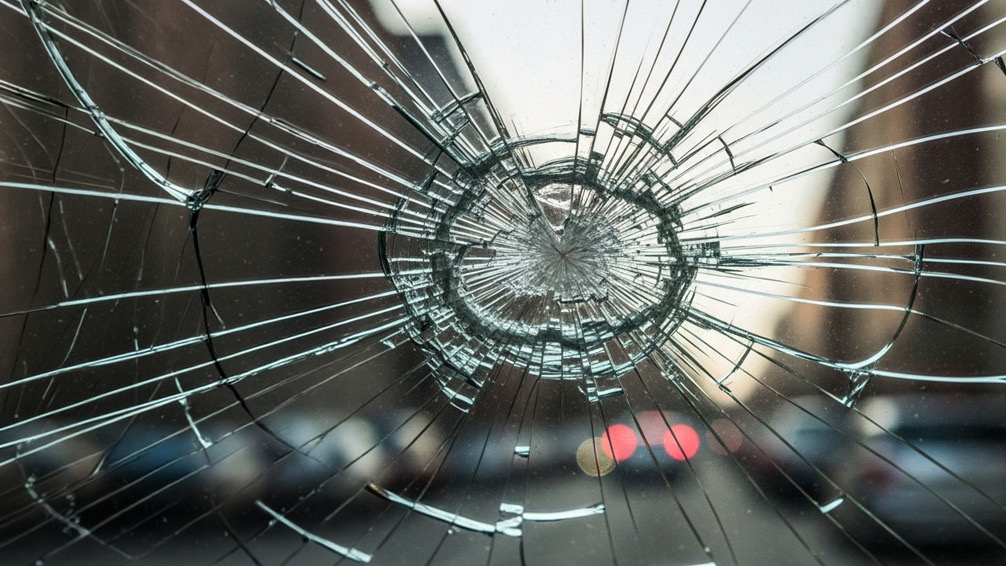
A fresh windshield chip looks like a tiny crater, sometimes with hairline legs radiating outward. Inside that crater, the glass surface is now jagged, irregular, and full of microscopic fractures. When the windshield expands and contracts every day under the Mission summer sun, all of that thermal stress concentrates exactly there.
The crack doesn't grow at a constant rate. It moves in jumps — a millimeter here, half an inch there — usually triggered by a specific event: a hot afternoon, a sudden A/C blast, a pothole on a country road, a slammed door, or even just opening the trunk on a 100°F day. Each jump opens fresh glass surface, which weakens the area further, which makes the next jump easier.
This is why we tell Mission drivers, every summer without fail: a chip that's smaller than a quarter today is a repairable chip. The same chip three weeks from now, after it has run six inches across your line of sight, is an insurance claim and a full windshield replacement. The cost difference is dramatic — usually ten times or more.
Hot Pavement, Cold A/C: The Thermal Shock Cycle
The single most damaging moment for a chipped windshield in Mission is the first ten minutes after you climb into a sun-baked car and crank the A/C to max. The outside surface of the glass is still over 140°F. You blast 50°F air directly across the inside of the windshield. The temperature differential between the two sides spikes within seconds.
That sudden temperature gradient is called thermal shock, and it's the most common trigger for a chip-to-crack transition we see in our McAllen shop. The crack often "runs" while the driver is still pulling out of the parking lot, sometimes audibly — a sharp tick or pop, and a line appears across the glass that wasn't there a moment ago.
You can reduce thermal shock with a few simple habits:
- Crack the windows for a minute before turning on the A/C, letting hot cabin air escape first.
- Start the A/C on a low fan setting and direct vents at the floor or your body, not at the windshield.
- Park in shade whenever you can — under a carport, in a covered lot, on the north side of the building.
- Use a reflective sunshade. It dramatically lowers the windshield surface temperature.
These steps don't eliminate thermal stress, but they soften the spike that triggers chip propagation.
Early Signs Your Windshield Chip Is About to Spread
Most cracks warn you before they run. If you have an existing chip, watch for these signs:
- Hairline legs growing longer. Tiny lines extending from the center of the chip — if they were a quarter-inch last month and now they're three-quarters of an inch, the chip is active.
- A new whitish "halo" around the impact point. That cloudiness is fresh micro-fracturing in the PVB interlayer.
- Audible ticking sounds when the temperature changes — first thing in the morning, after parking in the sun, or when the A/C kicks on.
- The chip looks deeper or darker. Heat has pulled the layers apart, and what was a surface ding now goes through the outer pane.
- Distortion in your line of sight. A chip that used to look like a dot now bends the light around it.
Any one of these signs means the clock is ticking. Get to a repair shop while the damage is still small enough to fix with resin.
When to Repair vs. When to Replace in the Rio Grande Valley
The industry standard most reputable auto glass shops follow — and the one we follow at A1 — works like this: a chip is generally repairable if it's smaller than a quarter and a crack is generally repairable if it's shorter than about six inches and not in the driver's primary line of sight. Anything larger, anything that has reached the edge of the glass, and anything obstructing the driver's view typically calls for replacement.
In Mission and across the Rio Grande Valley, our summer heat shifts that math. A chip that would be borderline-repairable in a cooler climate often crosses the replacement threshold within days here. We err on the side of fast action: if you have a chip, get it injected with resin this week, not next month.
If you're already past the repair window, our Windshield Replacement service uses OEM-equivalent glass with proper urethane cure times, and we handle ADAS recalibration on vehicles that need it. Not sure which category your damage falls into? Our team will inspect it for free and tell you straight which path makes sense.
How A1 Auto Glass Repairs Chips Fast Across Mission and the RGV
Our repair process for a typical Mission chip takes about thirty minutes from start to finish. We bring the vehicle into our McAllen shop or send a mobile technician directly to your home or office. The technician cleans the chip, draws a vacuum across it to remove air and moisture, then injects a specialized optical-grade resin. UV light cures the resin in a few minutes, restoring most of the windshield's structural integrity and dramatically reducing the chance the chip will spread.
A few things to know about our Rock Chip Repair service:
- It's almost always less expensive than a deductible, and many insurance policies cover chip repair with zero out-of-pocket cost.
- The repair won't make the chip disappear visually — you'll still see a small mark — but it stops the crack from spreading.
- We offer mobile service across Mission, McAllen, Edinburg, Pharr, San Juan, Alamo, and the rest of the Rio Grande Valley, so you don't have to drive a damaged windshield across town in the heat.
- For larger damage where repair is still possible, our Windshield Repair service handles longer cracks before they cross the replacement line.
Protecting Your Windshield Through South Texas Summer
Even if your windshield is currently chip-free, the Rio Grande Valley summer puts every piece of auto glass in the Valley through the wringer. A few habits go a long way:
- Park in shade or use a reflective sunshade — it can drop the glass surface temperature by 30 to 40°F.
- Replace worn wiper blades before the rainy season. Dragging hardened rubber across hot glass scratches the surface and creates new stress points.
- Keep a respectful distance from gravel trucks, which are common on the country roads around Mission. Most chips we see started life as a kicked-up piece of caliche.
- Get any chip looked at within a week, even if it seems minor. The least expensive repair you'll ever pay for is the one you make in the first seven days.
We've been serving Mission, McAllen, and the surrounding Rio Grande Valley for years, and we've seen every variety of summer heat damage South Texas produces. If you've got a chip you've been meaning to deal with — or you want a free inspection before your next road trip — bring it in before the next 100-degree afternoon.
Frequently Asked Questions
Can summer heat alone crack a windshield?
Heat by itself rarely cracks a perfect windshield, but it's the most common trigger for cracks to spread from existing damage. Pre-existing chips, edge stress from improper installation, and microscopic flaws all become vulnerable when the windshield surface heats past 140°F and then contracts rapidly under a blast of A/C.
How long does a windshield chip repair take in Mission, TX?
Most chip repairs take 25 to 40 minutes, and you can drive the vehicle immediately afterward. Larger crack repairs can take up to an hour. Mobile service in Mission lets us complete the work at your home, office, or job site so you don't lose a half-day driving across the Valley.
Will my insurance cover windshield repair in Mission, TX?
Texas comprehensive auto insurance policies frequently cover windshield repair with no deductible because resin repair is significantly less expensive than full replacement. Carriers prefer the smaller bill. We verify your coverage before any work begins so there are no surprises.
What's the best time of day to get a windshield repair in the Rio Grande Valley?
Morning is ideal. The glass is cooler, the resin cures more predictably, and you avoid driving a freshly repaired windshield through the hottest part of the afternoon. If morning doesn't work, our shop and our mobile units run climate-controlled environments that let us repair throughout the day.
Should I use a windshield sunshade in Mission?
Yes. A reflective sunshade can drop the windshield surface temperature by 30 to 40°F, which meaningfully reduces thermal stress on existing damage. Combined with shaded parking, it's the simplest and most effective summer habit for Mission drivers.